
Armstrong’s Templok Ceiling Tiles Show Promise for Thermal Energy Storage
Thermal storage built into ceiling tiles
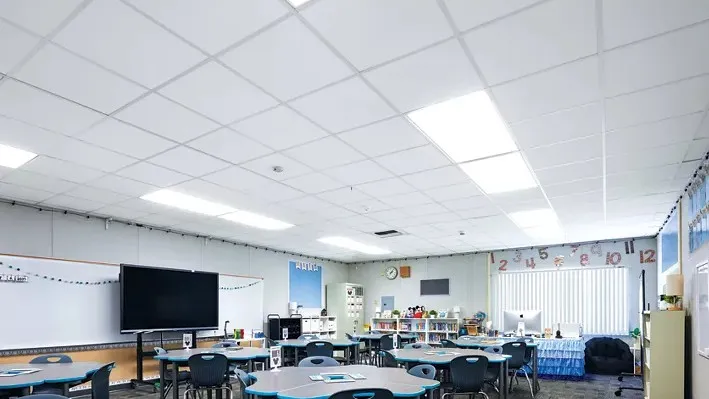
At the New York Build Expo, Armstrong highlighted its new Templok ceiling tiles, which integrate phase change material to provide passive thermal energy storage. The tiles look like standard acoustic ceiling panels and do not require complicated systems to operate, but they are designed to absorb and release heat as temperatures change.
According to Armstrong, the phase change material in Templok absorbs heat as it becomes liquid and releases heat as it solidifies, using a dissolution and crystallization process rather than simple melting and freezing. The material is a salt-based solution contained in a metallized polymer pouch attached to the back of a ceiling tile.
Armstrong says a single lightweight panel provides the same effective thermal mass as 11 bricks. Because the phase change occurs over a limited temperature range, the material can be formulated to absorb or release heat around room temperature. That allows it to moderate temperature passively across a large surface area while reducing the risk of condensation that would be more likely with colder, more concentrated cooling surfaces.
How the system works
Templok is designed so its phase change occurs at room temperature. Since heat rises, the ceiling is typically warmer than the floor, and a suspended ceiling tile also acts as an insulated partition between conditioned air below and the air space above. That means temperature swings above the tile can be greater than those felt in the occupied room, especially when the roof is directly above the suspended ceiling.
Because the phase change material cannot be cut, standard cosmetically matching ceiling tiles are used around edges and in locations where holes are needed for sprinklers, lights, or speakers. As a result, about two-thirds of the ceiling tiles in a typical installation contain the phase change material.
The company projects energy cost savings of up to 15% from the system. Actual performance depends heavily on conditions. If the tile stays at a steady temperature, little heat is stored or released and the benefit is limited. But when temperatures fluctuate at ceiling level or in the air space above the tile, the system can reduce electricity use even if room-level temperatures remain fairly constant. The article notes that the impact could be especially meaningful in desert climates with hot days and cold nights, or in buildings with set operating hours that allow temperatures to drift during off-hours.
Potential and economics
The technology could offer additional value if building temperatures are modulated slightly to trigger phase changes when electricity is cheap or when solar generation is abundant, allowing stored heat to be released or absorbed later when power prices are higher.
The article also notes that subsidies may improve the economics. Armstrong says 45E tax credits can cover up to 50% of the total cost of the ceiling, including the grid, trim, and labor, which could make the overall project less expensive than a traditional suspended ceiling despite the higher cost of the tiles themselves.
Broader uses for phase change materials
Phase change technology itself is not new. The article compares it with reusable hand warmers, melting ice in coolers, and older icebox concepts, all of which rely on storing and releasing heat during a material’s change of state.
Armstrong says its material is proprietary, but the article notes that other salt-based options exist and that different formulations can shift the temperature at which the phase change happens. That suggests broader potential uses, including in attics or crawl spaces, bedding and seating, hot water heaters, or larger connected thermal energy storage systems.
One of the main advantages highlighted for Templok is that it requires little user attention. It looks like a standard ceiling tile, maintains acoustic performance, and does not require special installation, wiring, or controls. The article concludes that while thermal energy storage alone will not solve all energy challenges, it is a practical and underused tool that can be deployed quickly and may become more useful as additional PCM-based products come to market.