
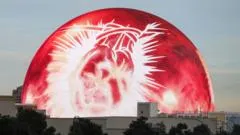
Can domes and spheres become the future of entertainment?
Immersive venues test the future of live entertainment
The Las Vegas Sphere has become a high-profile test of whether dome- and sphere-style venues represent the next phase of entertainment. For Danielle Renee, a longtime Backstreet Boys fan from Washington State, the experience felt unlike any concert she had seen before.
When she visited in early February, she was struck not only by the band's performance but by the giant concave screen covering much of the venue's interior. The stars overhead, the spaceship imagery and the surrounding visuals were all graphics. She said "nothing compares" to the new show and described the audience as dancing and singing along throughout.
Supporters of these venues say they offer something more immersive and experiential than traditional concerts or cinema. But the industry still faces a familiar challenge: proving that audiences will keep returning, rather than treating the format as a novelty in the way many did with 3D cinema.
The Sphere's early test
The Las Vegas Sphere, which cost $2.3bn (£1.72bn), has hosted a range of productions since opening in September 2023, including a new version of *The Wizard of Oz* with added visual effects and a residency by U2. Tickets generally cost at least $100, and sometimes much more.
For years, commentators questioned whether such a venue could make money. Early in 2025, observers pointed to the Sphere's continuing financial struggles, and at least one critic said a visit left them confused and slightly dismayed.
But as more shows arrived, the business picture improved. In February, Sphere Entertainment reported net income of $57.6m for the 2025 calendar year. The company declined to comment for the article.
Spectacle, skepticism and expansion
Not everyone is convinced that more immersive always means better. Manel González-Piñero, a creativity and innovation researcher at the University of Barcelona who has seen *The Wizard of Oz* at the Sphere, said that for him, watching a movie is already enough of an experience without added layers.
Even so, he described the Sphere as a "prototype" that appears to be working as a unique content format. He was less certain that smaller versions planned for other cities would be as suitable, suggesting the Sphere may make more sense as a one-off attraction tailored to Las Vegas.
Ben Wood, chief analyst at FDM/CCS Insight, had a different reaction after visiting, calling the venue "jaw-dropping". He argued that giant concave-screen venues can make audiences feel as though they are experiencing a form of augmented or virtual reality. At the same time, he acknowledged that some people may be put off by the scale and visual excess, including the Sphere's giant animated exterior display.
Rivals build on the concept
Other companies are also betting on immersive screens. Cosm, which grew out of a merger involving projection technology firm Evans & Sutherland, is developing dome-like venues where audiences can watch live sports or films enhanced by surrounding visuals.
The company says it is focused heavily on software, while also using specially designed LED systems for its curved domed displays. Cosm already has venues in Los Angeles, Dallas and Atlanta, with sites planned for Cleveland and Detroit.
Chief product and technology officer Devin Poolman said the long-term goal is to have more than 100 venues worldwide, though he declined to say whether the business is already profitable.
An old idea with new technology
Dome-based entertainment is not entirely new. Cinerama built dome-shaped cinemas in the US in the 1960s, and Imax followed in later years.
James Lanier, founder and president of Absolute Hollywood, said there is something distinctive about fully illuminating the inside of a dome. Since the late 1990s, his company has created temporary and semi-permanent inflatable domes for projected shows. Unlike the Las Vegas Sphere, he noted, visitors are usually free to walk around or lie down and look upward during the experience.
He recalled one installation for a royal wedding in the Middle East, where singers and dancers performed in nearby tents and were then projected into a central dome for guests. He described it as a surreal experience.
Captivating enough to return
Whether immersive domes and spheres become a lasting mainstream format remains uncertain. The technology has clear advocates, but it still must prove it can move beyond spectacle and novelty.
For some visitors, however, the appeal is already strong enough to bring them back. Renee said she had already received information about the Backstreet Boys' final shows of the summer and was looking into how she could return.