
Clara Deser tells UW audience climate change reflects both human influence and natural variability
Lecture on climate outcomes
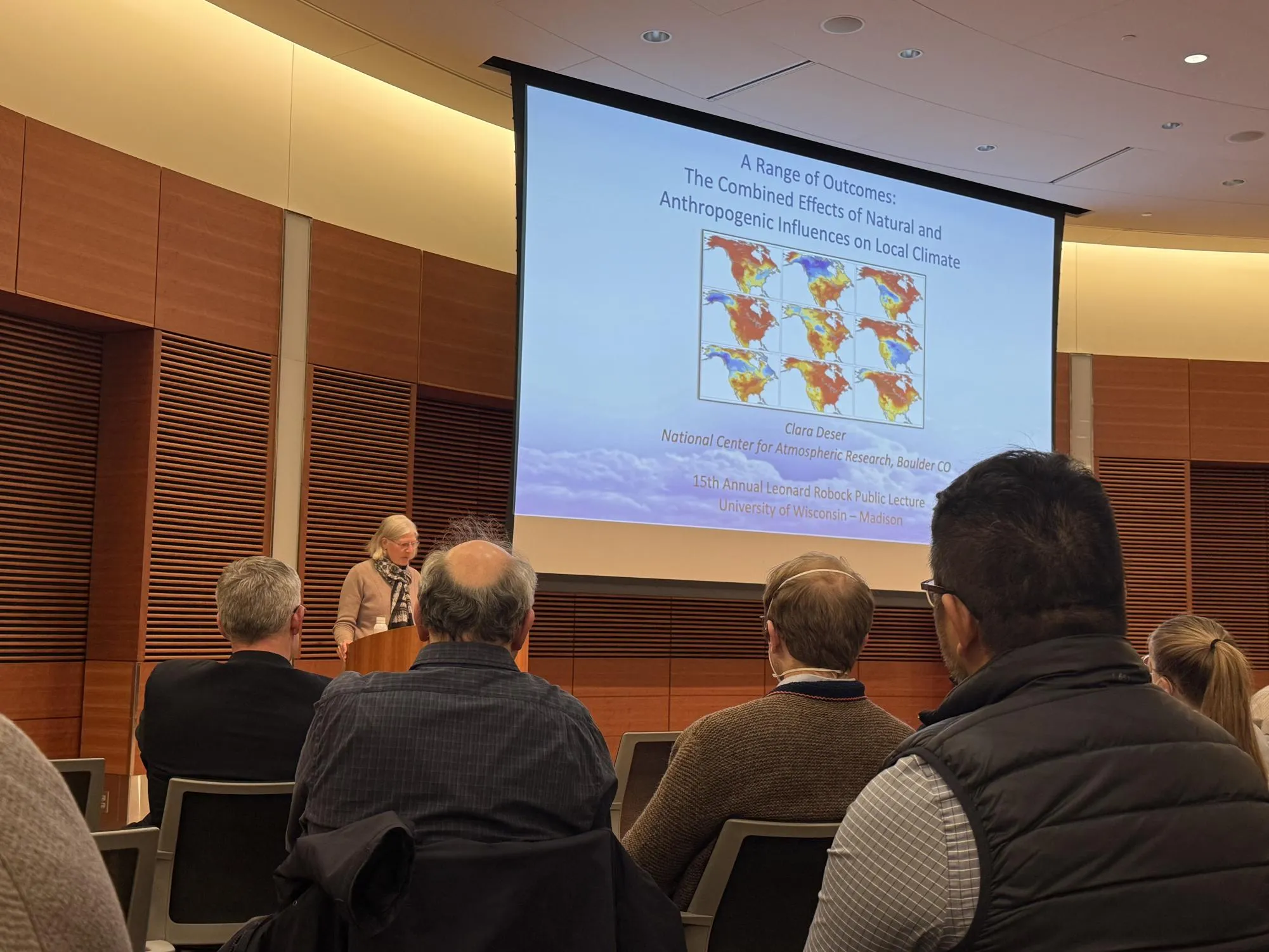
The University of Wisconsin Department of Atmospheric and Oceanic Sciences welcomed Clara Deser, a senior scientist at the National Center for Atmospheric Research in Boulder, Colorado, to deliver the 15th Annual Leonard Robock Lecture on March 24. The annual lecture series features an expert on a topic of public interest in an effort to embody the Wisconsin Idea and educate the public on current knowledge.
Deser’s talk, titled “A Range of Outcomes: The Combined Effects of Natural and Anthropogenic Influences on Local Climate,” focused on how natural climate variability and human influence combine to shape present-day weather and the range of outcomes expected from future climate change.
She said carbon dioxide levels have increased 54% over the last 2,000 years and that, if recent rates of change continue, the world is on track to see a doubling of CO2 in about 30 years.
Human influence and natural variability
Deser said human-induced climate change is irrefutable and grounded in direct measurements and the laws of physics. She identified fossil fuel burning as the primary anthropogenic driver, while also citing deforestation and depletion of the ozone layer by chlorofluorocarbons as contributors to the greenhouse effect and continued planetary warming.
At the same time, she said natural climate variability remains crucial to understanding climate because of interactions between the ocean and atmosphere. These include internal fluctuations, solar and orbital cycles and volcanic eruptions. According to Deser, atmospheric dynamics drive habitual weather patterns and can be predicted up to a few weeks in advance, while regular oscillations can be forecast up to a decade out.
“The predictability time horizon for the natural variability within the climate system is weeks to a decade at most,” Deser said. “Beyond that, time horizon is a roll of the dice.”
Challenges in regional projections
Deser said natural variability makes future climate projections more difficult at regional and local scales because a range of possible outcomes emerges in different places. She said that when global warming is assessed from a continental or national perspective, regions with especially high variability can be overlooked.
She pointed to the National Center for Atmospheric Research Community Earth System Model, which she helped develop, as a tool for computing different climate trajectories that account for both anthropogenic influence and natural variability across regions. According to Deser, the model can reproduce outcomes seen in the real world while also generating other possible scenarios based on shifts in natural fluctuations.
Deser concluded by emphasizing that today’s climate reality is not the only one that could have occurred and that alternate outcomes remain possible, particularly as technology improves. She said future research questions include the potential of higher-resolution Earth system models and AI-based prediction skills.