
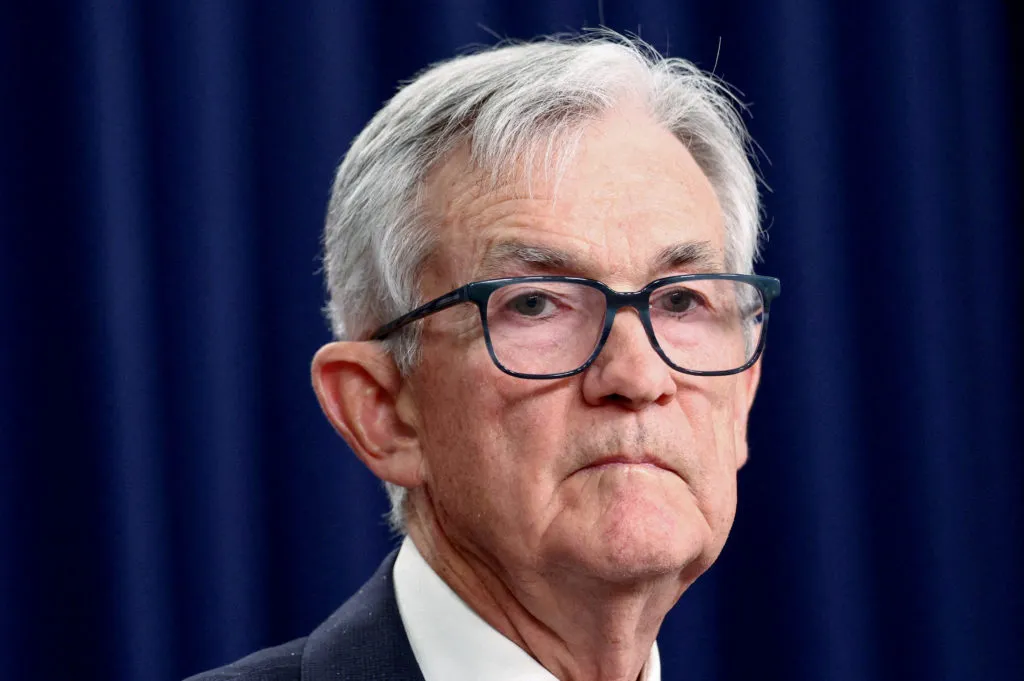
Powell says energy price spike raises inflation concerns as graduates face weak job market
Powell warns on inflation risks from energy shocks
Federal Reserve Chair Jerome Powell said Monday that policymakers need to closely monitor inflation as energy prices rise because of the war in Iran.
Speaking to nearly 400 students at Harvard University, Powell said there was not much the Fed could do directly about higher energy prices because such shocks “tend to come and go pretty quickly,” while monetary policy works over a longer time frame. Still, he said a series of energy shocks could become more concerning if they begin to affect public expectations for future inflation.
“You have to carefully monitor inflation expectations because you could have a series of big supply shocks and that can lead, you know, the public generally, businesses, price setters, households ... to start expecting higher inflation over time,” Powell said.
The average price of a gallon of gas in the U.S. rose to $3.99 overnight, according to AAA.
Challenging market for young workers
In wide-ranging remarks, Powell also said young graduates are entering a difficult job market. He noted that while unemployment remains historically low, job creation has been very limited.
The U.S. labor market has been weak for the past year. Employers added fewer than 10,000 jobs a month in 2025, the weakest hiring outside a recession since 2002. After 126,000 jobs were added in January, the U.S. then lost 92,000 jobs the following month.
Economists have described the current environment as a low-hire, low-fire job market, in which companies are reluctant to add staff but also hesitant to let go of existing workers. That has made it especially hard for young people to find jobs. Powell also pointed to artificial intelligence as a factor shaping the market for entry-level work.
Despite those challenges, Powell said he remains optimistic over the medium and long term. He said technological advances have historically boosted living standards and output, and that large-language models are already making people more productive.
“You're in a situation where you need to really invest the time to master the use of these new technologies,” Powell said. “There's no denying it's a challenging time to enter the labor market. It may take some patience and all that, but in the longer term, this economy is going to give you great opportunities.”
Fed independence and political pressure
During a question-and-answer session, Powell stressed the importance of the Federal Reserve’s independence, even though neither he nor the students mentioned President Donald Trump by name.
“It’s very hard to build great democratic institutions and much easier to bring them down,” Powell said.
Trump has repeatedly urged Powell and the Fed to cut interest rates, while some policies under his administration have complicated the central bank’s dual mandate of stable prices and maximum employment. New tariffs have the potential to lift retail prices, while the war in Iran has pushed energy prices higher.
Powell also offered advice to his eventual successor without naming anyone directly, saying it was “very important to stick to your knitting and to stick to the things that were actually assigned.” He said the Fed’s tools are meant for maximum employment, price stability and financial stability, and should not be redirected for other political purposes.