
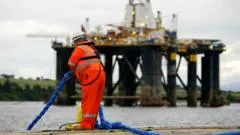
UK must back North Sea oil and gas drilling, says trade body
Trade body urges support for North Sea drilling
The offshore energy industry has warned that the UK "urgently" needs to produce more of its own oil and gas and has called on the government to support North Sea exploration.
Offshore Energies UK said that without greater domestic production, the country risks becoming more reliant on imports at a time of rising global instability. The warning comes after oil and gas prices spiked during the conflict involving the US, Israel and Iran, and after Tehran effectively shut the Strait of Hormuz, a key route for global crude supplies.
The group said the issue should not be framed as a choice between renewables and fossil fuels. In a report published Tuesday, it said oil and gas still supply about 75% of the UK’s energy needs and will account for around a fifth of demand by 2050. It argued that demand remains strong even as domestic production declines, leaving households exposed to potential price shocks.
Government rejects licensing argument
The Labour government has banned new licences for new oil and gas fields in the North Sea. A government spokesperson said issuing exploration permits "cannot give us energy security and will not take a penny off bills".
The spokesperson added that oil and gas, wherever it is produced, is sold on international markets, meaning Britain remains a price taker. Energy Secretary Ed Miliband recently said the lesson from the current crisis, which has pushed oil prices up by more than 30%, is that the UK needs "home-grown, clean power that we control".
Offshore Energies UK chief executive David Whitehouse said recent events showed how quickly energy markets can tighten and how easily cargoes can be diverted away from the UK when other buyers pay more. He said the country urgently needed greater supplies of secure, domestically produced energy, including oil and gas, which he said would remain a critical part of the UK energy system and economy for decades.
Industry and political pressure builds
The industry body wants the government to review its approach to offshore exploration licences after last year’s ban. Under current rules, developers can only increase production in areas already covered by an existing licensed field, or in adjacent areas, to keep those sites viable.
It is also calling for the Energy Profits Levy, the windfall tax on producers, to be scrapped in 2026, four years earlier than planned. It says the levy should be replaced with an Oil and Gas Price Mechanism that would impose a 35% tax when prices rise above a certain level. Under the current regime, energy companies pay 78%. Offshore Energies UK says the change could unlock £50bn of new investment in UK oil and gas.
The Conservative Party is also pressing the issue, using an Opposition Day debate in Parliament to call for an end to both the levy and the ban on new oil and gas licences. It also wants the government to approve the Rosebank and Jackdaw Scottish oil and gas fields after a court blocked the move last year.
Critics dispute impact on bills
The Court of Session in Edinburgh ruled that the developers of Rosebank and Jackdaw had failed to properly assess the likely environmental impact and ordered them to seek fresh approval after a case brought by Uplift and Greenpeace.
Claire Coutinho, the shadow energy security secretary, said rejecting domestic gas that could heat millions of homes would be "madness in normal times" and "sheer lunacy in the midst of a gas supply crisis".
But researchers at the University of Oxford have disputed claims that greater North Sea extraction would significantly lower UK energy bills. They said that even if the UK maximised North Sea production and returned revenues directly to households, the savings would be much smaller than those likely from accelerating the shift to renewable energy.
Greenpeace UK also rejected the industry’s case. Mel Evans, the group’s head of climate, said more drilling would not cut energy bills or petrol prices but would instead maximise oil and gas revenues during a period of high prices, when fossil fuel companies could profit even more.